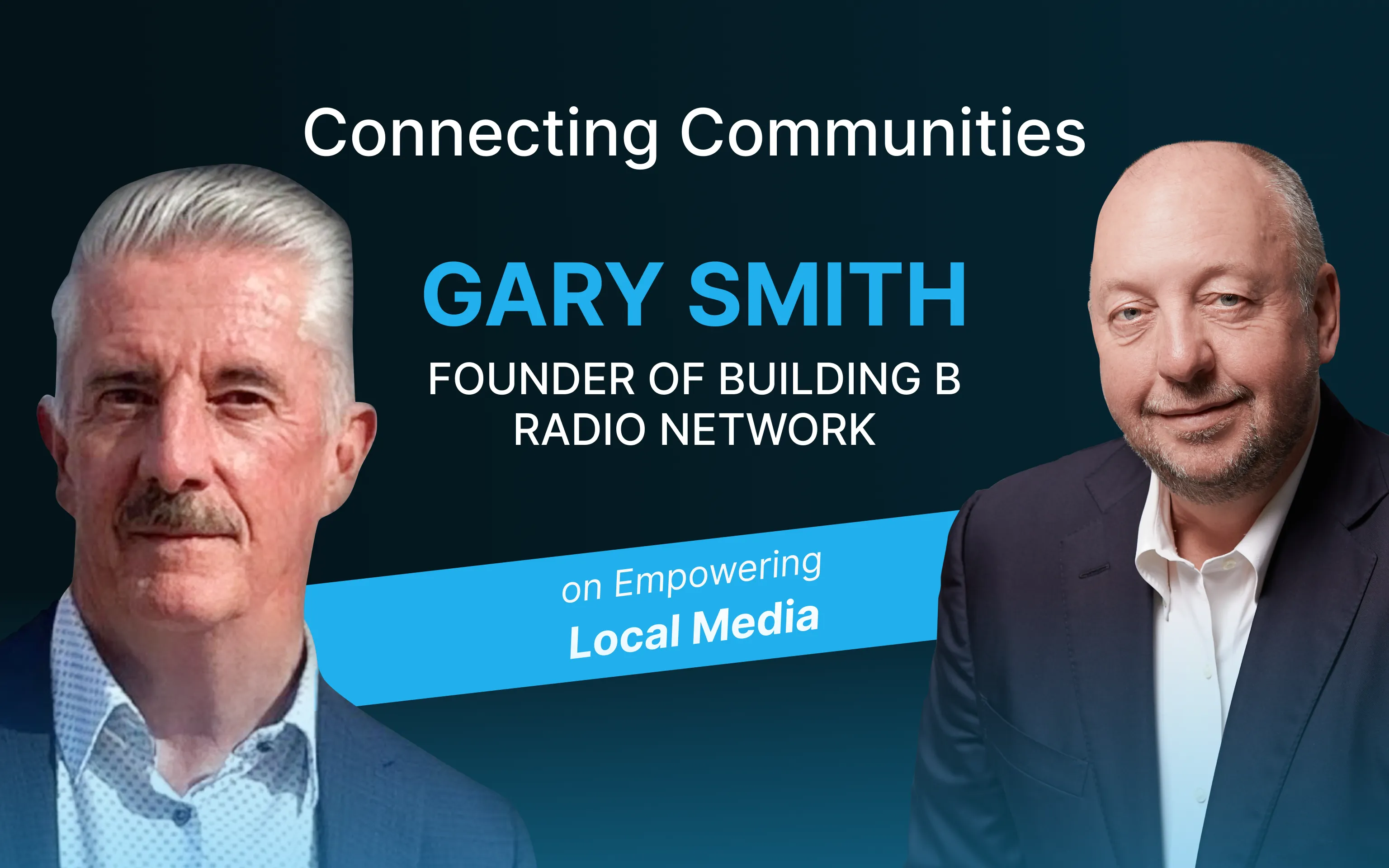
Jonathan Herps: Welcome back to Entrepreneurs Stories: Scaling Up — Episode 106. Today I'm joined by Gary Smith, Founder and CEO of B Radio Network. Gary, welcome to the call.
Gary Smith: Good morning Jonathan, thanks for inviting me — I'm looking forward to our conversation.
Jonathan: Tell us about your entrepreneurial journey and how B Radio Network came to be.
Gary: It started entirely by accident — which is probably how a lot of businesses begin. My background was big-end-of-town corporate: I was a Director at American Express, ran one of their Australian divisions, and had extensive experience in travel working for Jetset among others.
When my boys were young, my wife enrolled them in rugby at our local club. I was slow getting off the field one morning after dropping them to training, and someone said, "Gary, you look like you could be a team manager." That was the beginning. I became the team manager, then the coach — and when I looked more closely at the club's finances, I saw they were essentially operating hand to mouth, waiting on registration fees just to buy new jerseys.
I volunteered for the committee and decided to treat the club like a normal business. Over time, I turned it into what I believe became the financially strongest junior rugby club in the country — we invested hundreds of thousands of dollars upgrading facilities, put lights on the oval, and the club became a model for others. Other clubs started contacting me and asking if I could do the same for them. I said yes — but I'd charge for it. And I thought: there's a business here.
I built that up fairly quickly to 50 clubs and 100,000 members. At that point I realized what I actually had was a media network — connecting businesses that wanted to reach community audiences at a hyper-local level. When I approached major telecommunications companies and large corporates, the feedback was consistent: "Love it, but come back when you're bigger." So I went back to the clubs, explained we'd need to forgo some short-term revenue to grow the network into something substantial, and they agreed.
Over the ensuing years I scaled from 50 clubs to 6,000 clubs, and from 100,000 members to 4 million members. We became major sponsors — appearing on the jerseys of around 20,000 players across the country — and naming sponsors of competitions. We eventually reached 8,000 clubs and 7 million members. Then COVID hit and wiped everything out. Community sport stopped. Local businesses shut down. Revenue disappeared.
In the middle of COVID, a colleague with a background in journalism and television introduced me to independent community radio stations. I immediately saw the parallel — volunteer-run organizations, great community reach, but almost universally poor at generating commercial revenue because major corporations and government agencies couldn't manage relationships with hundreds of individual stations. We had spent years learning exactly how to solve that problem through our sport network, and I realized we could apply the same model to radio.
That was just over 18 months ago. We now have 121 radio stations across Australia in our network, with an audience approaching 4 million people — which I believe makes us the largest radio station network in the Southern Hemisphere. We plan to grow to approximately 200 stations by the end of this year. We're also integrating local newspapers into the platform and returning to our roots by supporting community sport through radio — many of these stations already cover local games and outside broadcasts. By bringing sport and radio together, we've created a genuine hyper-local marketing platform that can reach consumers at every individual touchpoint within a community.
Jonathan: If you were starting from scratch, what personal or leadership development areas would you prioritize?
Gary: Two things stand out. First — cash flow and accounting. In a large corporation, entire departments handle that. You receive your reports and everything simply happens. In small business, you start every week asking yourself how you're going to have enough money to pay your people at the end of it. Getting that right from day one is foundational. Second — the people you bring on board. It's very easy to hire people who are similar to you, or people you simply like. What you actually need is clarity on what value they will add and whether their values are genuinely aligned with yours. Those are probably the two biggest lessons I've learned the hard way.
Jonathan: What qualities do you look for in employees, and how do you build a positive culture?
Gary: Relevant skills and capability matter, of course, but in our business the non-negotiables are a genuine commitment to community and a deep sense of honesty. I don't want people who say what they think others want to hear — I want people who are direct, transparent, and completely open. And I look for a strong moral compass: no corner-cutting, no behaviour that negatively impacts the people we work with. If you have those foundations in place, everything else can be built. But without them, you have nothing to build on.
Jonathan: What's been your biggest learning as a business owner?
Gary: The most profound learning has been understanding volunteer and not-for-profit community organizations — what drives their loyalty, what motivates their members, and how to build something that genuinely works for everyone involved. The core principle is that every relationship has to be an everybody-wins arrangement. If it isn't, the future is limited.
On a personal level, my measure is simple: every morning when I shave, I want to be comfortable with the person looking back at me. That's my compass. Whatever I do has to feel right. Early in my career in consumer finance, there were practices I'm not proud of — things that wouldn't be remotely acceptable today. Those experiences shaped a very strong commitment to doing business the right way.
Jonathan: What are the main challenges facing your business now and going forward?
Gary: The status quo among major global media players is our biggest challenge. To be truly successful, we need major corporations directing advertising spend our way. But those corporations work through major media buyers who have long-term, locked-in agreements with the large established networks. Changing that structural dynamic takes time — years, not months. We are building our network and growing our market presence steadily, and I believe the answer lies in brand awareness: the more companies understand who we are, the more likely they are to ask their media buyers directly why B Radio Network isn't in their plan. Determination and perseverance will get us there — step by step.
Jonathan: When you think of the word "successful," who comes to mind?
Gary: Two people immediately stand out: Jeff Bezos and Richard Branson. What they share is almost-against-all-odds determination. Bezos took six to seven years before Amazon turned a profit in any single year — and in his final pre-profit year, he lost two billion US dollars. To maintain direction, stay motivated, and keep going through that requires nerves of steel. Branson has a similar story — using ingenuity and sheer persistence to build from almost nothing. Both reinforce the same truth: if you're going into business, it will be genuinely hard. You are a gambler making your best-informed bet, and then you have to be determined enough to see it through.
Jonathan: Any books or podcasts you'd recommend?
Gary: Richard Branson's Like a Virgin was a tremendous read for me — it captured that spirit of determination and seizing opportunity. I'd also recommend Westpac: The Bank That Broke Australia — a fascinating and sobering account of how wrong decisions and a degree of arrogance almost brought down the country's oldest bank. Learning from others' failures is just as valuable as learning from their success.
Jonathan: Any final advice for entrepreneurs?
Gary: Seize the opportunity — but always work collaboratively with the people around you. The idea that led to our radio network came from a colleague with deep media experience. Two years ago I had never heard of community radio. It was her knowledge and expertise that made the connection visible. The people already on your team are a wealth of knowledge and experience. Work with them, listen to them, and build collectively — because the best decisions rarely come from one person alone.
Jonathan: Gary, thank you so much — as always, there are genuine nuggets of wisdom in every answer.
Gary: My pleasure, Jonathan. Thank you very much for having me.






.webp)
.webp)