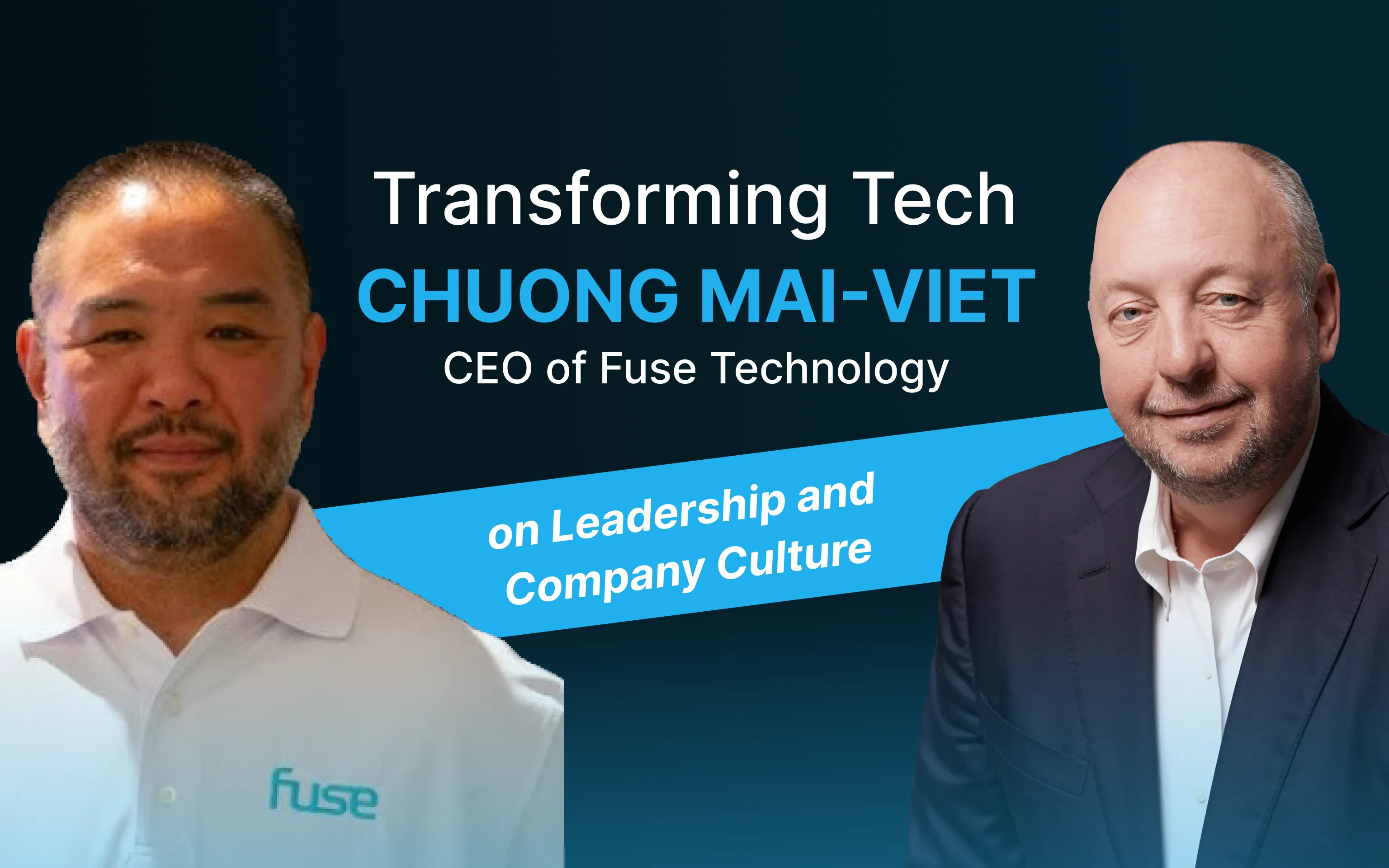
Jonathan Herps: Welcome back to Entrepreneurs Stories: Scaling Up — Episode 116. Today I'm joined by Chuong Mai-Viet, Director of Fuse Technology. Chuong, welcome.
Chuong Mai-Viet: Thanks Jonathan, nice to meet you.
Jonathan: Tell us a bit about your entrepreneurial journey and the story behind Fuse Technology.
Chuong: I started life as a Microsoft engineer back in the 1990s. I studied mechanical engineering at university, discovered I preferred computers, considered programming but found it wasn't quite right either — and ended up landing a warehouse role at a reseller called Leading Solutions, fitting memory sticks and LAN cards. I worked my way up from there, became a Microsoft engineer, and eventually joined Brennan IT, where I spent 11 years progressing from field engineer all the way to CEO.
After 11 years it was time for a change. I moved to Ethan Group and ran their managed services practice for three and a half years. Following that, an opportunity emerged to establish an Australian subsidiary for a UK business called Blue Source. I took a small equity stake, drew a modest salary, and built that business from scratch. After about three years, it became clear the business was fundamentally built around me — so I executed a management buyout, acquired the majority of shares, brought in a couple of colleagues as minority equity holders, and took full ownership.
A few years later, COVID hit. We used that period to rebrand the business as Fuse Technology, and we've been building ever since. We're now approaching 40 staff, projecting $11–12 million in revenue this year, and have a presence in Sydney, Melbourne, Brisbane, New Zealand, and the UK. We've also recently established a five-person service desk in Vietnam — not for cost reasons, but for talent. With a population of 100 million people and a highly educated workforce, Vietnam offered access to the calibre of service staff that is increasingly difficult to find in Australia.
Jonathan: If you were starting from scratch, what personal or leadership development would you prioritize?
Chuong: Without question — investing more deliberately in growing people. The biggest insight from my journey, both at Brennan and at Fuse, is that people stay when they feel they are growing. Most people aren't primarily driven by money — they're driven by learning, development, and working alongside people they genuinely like and respect.
If I could go back, I would build stronger systems and processes around learning and internal promotion from day one, and I'd be far more willing to hire junior talent and invest in their development over the long term rather than paying a premium for senior external hires. Two of my best salespeople today both started as graduates with us seven years ago. One of them is now my Head of Sales. That outcome tells me everything I should have been doing more of from the beginning.
Jonathan: How do you balance personal life with the demands of running a growing business?
Chuong: I have four children under the age of 11, which doesn't make it easy. But my wife is exceptional — after our last child, we made the decision for her to stop working, which gave our family the flexibility the business required. It was financially stressful at the time, but it was the right call.
My approach has always been to protect the moments that matter most. Being there for breakfast, getting the kids off to school, sitting down for dinner together every night — those are the non-negotiables. I travel when I need to — I spent six or seven weeks overseas last year — but I schedule it during school weeks so the kids don't feel the absence. When I am home, I am fully present. That distinction matters enormously.
I'm also an early riser, which means I get a block of focused work done before the household wakes up. And after the kids are in bed, I'll check in on whatever can be handled asynchronously. The key is intentionality — you're building this business for your family, but there's no point building it if you're not part of their lives in the process.
Jonathan: What do you look for in employees and how do you build a positive culture?
Chuong: The first filter is simple — and I'll be direct about it: we have a strict no-decks policy. I don't care how technically strong someone is; if they don't fit culturally, if they're not someone the team genuinely likes, they won't succeed with us. Culture fit comes first.
Second is growth mindset. We are not looking for people who want to do the same job for 20 years. We want people who are hungry, who want to learn, who are excited about where a career can take them. That orientation toward growth is essential. We're only 40 people, but I have a dedicated Head of People and Culture — because growing from 20 to 40 staff in two years requires intentional leadership of that function. You cannot build a successful people business without it.
Jonathan: What's been your biggest learning as a business owner?
Chuong: Don't sweat the small stuff — and make decisions. Over the years, I've watched the damage that analysis paralysis does to a business. It's better to make a mistake quickly, learn from it, and course-correct than to stall indefinitely trying to find the perfect answer. There rarely is a perfect answer.
I use a golf analogy with my team: when you hit a ball under a tree, you can try to be a hero — or you can take your medicine, punch it back to the fairway, and get on with the round. The same applies in business. Take your medicine, don't dwell on it, don't rehash the past, and move forward. Life is too short — and a business that can't make decisions quickly will always be outpaced by one that can.
Jonathan: What are the main challenges you're facing now and going forward?
Chuong: The biggest challenge is macro factors outside our control — geopolitical events, economic shocks, wars, natural disasters. We're well-positioned in that no single client represents more than 10% of our revenue, and our client base is predominantly in professional and financial services, which provides some insulation from broad economic volatility. But what our clients are experiencing is still something we feel indirectly.
Scaling without compromising quality is the other major challenge. I still like to stay close to our key clients personally, but I know we'll reach a point where that's not possible at scale. Building the right team — people who can identify the early warning signs when something isn't tracking as it should — is how we address that. Payment delays from larger clients have also become more common recently, which creates cash flow pressure, but we've built enough flexibility to manage through it.
Jonathan: When you think of the word "successful," who comes to mind?
Chuong: In our industry, Apple stands out — not because of scale, but because of their consistency of execution. It's rare for them to miss a shipping date or release something that genuinely disappoints. I tell my team: I don't need us to be the best in the world, but I want us to be the most dependable. Think of a great mid-range restaurant — not fine dining, but a place you go back to week after week because you know exactly what you're going to get and it always delivers. That consistent, quality execution is what I aspire to.
I also admire what Satya Nadella has done with Microsoft — turning a company that had become unpredictable and stagnant into one that consistently delivers on its promises. That transformation is remarkable, and it's a model worth studying.
Jonathan: Any books or podcasts you'd recommend?
Chuong: Atomic Habits by James Clear has been genuinely transformative for me — I'm not a naturally disciplined person, and the framework it provides for building structure into daily life has made a real difference. I'd also recommend David Goggins' Can't Hurt Me — a revelation in terms of what's possible mentally. And for something lighter, Phil Knight's Shoe Dog is a wonderful read. On the podcast side, The Vergecast for technology, and the All-In Podcast for a window into how American venture capital actually thinks. Jonathan also recommended Marshall Goldsmith's Triggers and Hamish Blake's How Other Dads Dad — both added to the list immediately.
Jonathan: Any final advice for entrepreneurs and business owners?
Chuong: Enjoy your life — don't defer it. Too many entrepreneurs fall into the trap of telling themselves they'll enjoy it once they've made it. But "once I've made it" may never come, and even if it does, you may have damaged the things that actually matter along the way — your health, your relationships, your family.
Every Friday morning I play golf with the same group of mates. Most of them are entrepreneurs or business owners. We're done by 10:30 and I'm back at my desk by 11. That two hours gives me more back in energy and perspective than most things I could do with that time. Find your version of that — cycling, golf, a walk, whatever it is — and protect it. Smell the flowers. You're building this for a reason, so make sure you're actually living it.
Jonathan: Chuong, that is a perfect note to finish on. Thank you so much.
Chuong: Thank you, Jonathan. Always good to reflect on the journey.






.webp)
.webp)